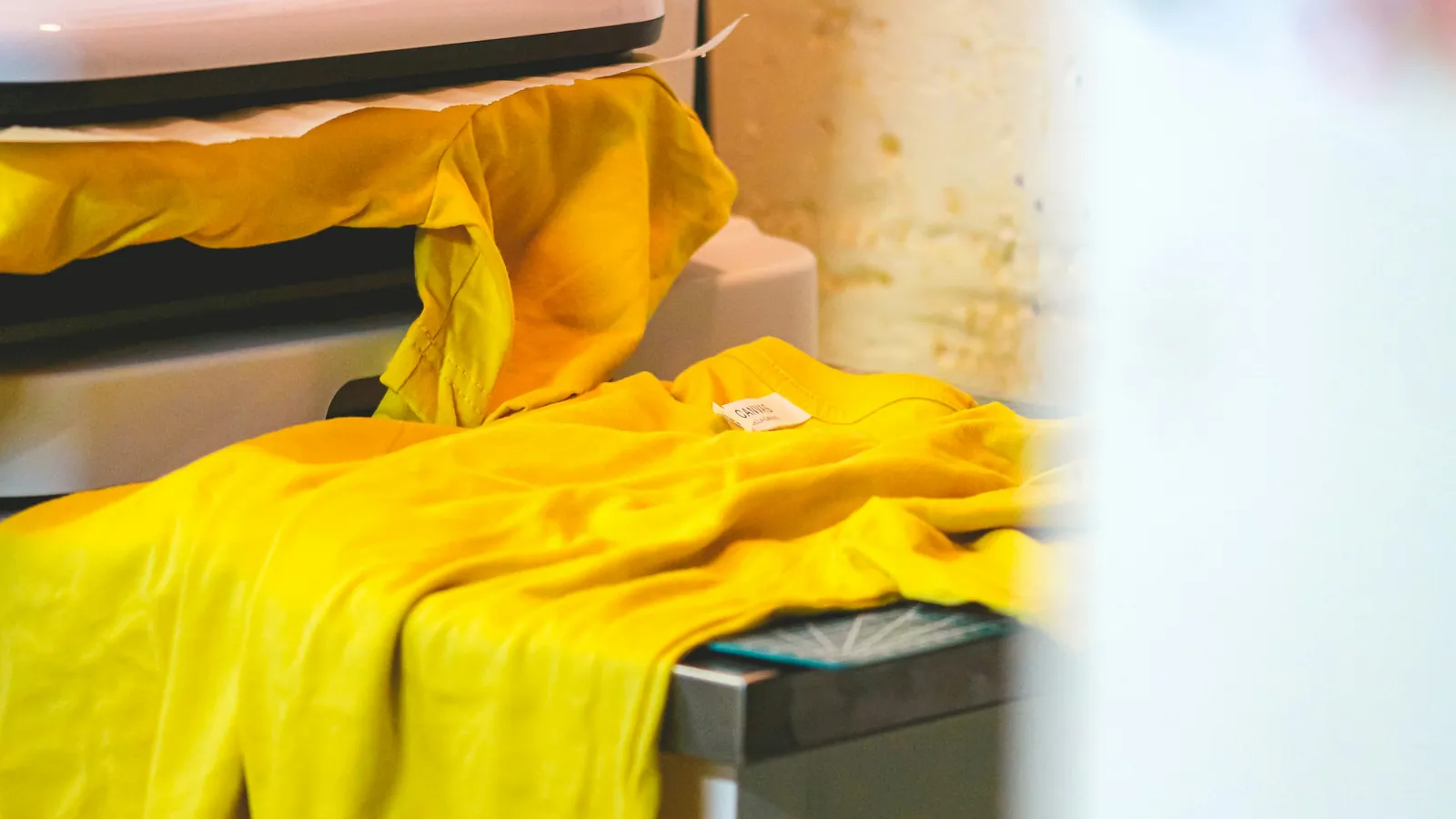
Short answer: a DTF (direct-to-film) printer is an inkjet printer that prints a design on a clear PET film in color, then in white. You cover the wet print with adhesive powder, melt the powder with heat, and press the film on a garment. The design moves to the fabric and the film peels off. It works on cotton, polyester and blends, light or dark.
How does a DTF printer work?
Think of it as making a high-quality iron-on, one at a time, in your own shop. The printer does the first step; the rest happens around it.
- Design and RIP. Special software (a RIP) mirrors the image and adds a white layer under the colors. Every printer we compare ships with its own.
- Print. The printer lays down CMYK, then white on top, on a coated PET film. InkSonic gives 3 to 6 minutes for a print on its R1390 page; Procolored states 7 to 12.5 minutes for a letter-size print depending on the model.
- Powder. While the ink is wet, you coat it with hot-melt adhesive powder and shake off the excess. A shaker machine can do this for you.
- Cure. The powdered film goes in an oven until the powder melts into a glossy layer. InkSonic's R1390 page gives 302 to 356°F for this step.
- Press and peel. A heat press bonds the transfer to the garment (InkSonic: 275 to 320°F for 30 seconds), then you peel the film.
That white layer is the whole trick. It sits under the colors once the transfer is on the shirt, so a bright design stays bright on a black hoodie.
What do you need for DTF printing besides the printer?
"DTF printing equipment" is a short list, and it is the same for every brand:
- DTF inks: cyan, magenta, yellow, black and white. Each brand asks you to use its own for the warranty to hold.
- PET film, in sheets or rolls. A 13-inch by 328-foot roll costs $89 at InkSonic.
- Adhesive powder: $39 a kilo at xTool and InkSonic, $55 at Procolored.
- A curing oven, or a shaker-dryer if you print rolls all day.
- A heat press. A home iron does not hold an even temperature across a full design.
- A computer, almost always running Windows.
Most sellers bundle part of this list. Our DTF printer price guide adds up a complete start-up budget, and the kits with an oven or a shaker are ranked on their own page.
What can a DTF printer print on?
Fabric, mostly. xTool lists cotton, polyester, denim, canvas, spandex and nylon for the Apparel Printer Plus; Procolored says the F13 prints for "almost any fabric", any color, with no pretreatment. In practice that means t-shirts, hoodies, tote bags, caps, aprons and patches.
Size is the limit to watch. An A4-class printer such as the Procolored F8 Panda prints 8.2 inches wide: fine for left-chest logos, kids' tees and sleeves. A 13-inch printer covers a full adult front. Hard goods like mugs and phone cases are a different process, called UV DTF, with different machines; we do not rank those here.
How is a DTF printer different from a regular inkjet printer?
Three differences, and they explain the price.
- White ink. It is heavy pigment that settles. Purpose-built DTF printers circulate it (every 30 minutes on the Procolored K13 Lite) and some stir it too.
- Self-cleaning. The head cleans itself on a timer: every 10 hours on Procolored's entry models, every 12 on the InkSonic Spark F13, every 4 on the DTF Station Prestige R2 Pro.
- Film handling. A roll feeder, a cutter and a heated platen replace the paper tray.
You will see converted photo printers sold as cheap DTF machines. They can print, and they skip most of those protections. We explain what that means, and what Epson says about its warranty, in the Epson ET-8550 DTF conversion guide.
What are the types of DTF printers?
For a small shop there are three useful families.
- A4 desktop (8.2 in): one head, about 22 lb, from $1,599. A starter for small designs.
- A3 desktop (13 in), single head: the heart of the market, $1,899 to about $3,200. See the Procolored K13 Lite review, the InkSonic Spark F13 review and the HTVRONT D2 review.
- A3 desktop, dual head: two heads print color and white in one pass, for 30 to 50 square feet an hour. From $4,899.
Above that come 24-inch roll machines for print shops, usually sold through dealers on a quote. One hybrid sits apart: the Epson SureColor F1070 prints both directly on garments and on DTF film.
How fast is a DTF printer?
Speed is where desktop models differ the most, and the brands do not all measure it the same way. Procolored counts letter-size prints per hour: 5 on the K13 Lite, 6 on the F13 Panda, 8 on the P13 and the F8 Panda. HTVRONT states up to 16 square feet an hour for the D2. The dual-head xTool Apparel Printer Plus is stated at up to 50, and the DTF Station Prestige R2 Pro at 30 to 35.
To compare them we convert everything to square feet per hour: a letter-size sheet is about 0.65 square foot, so 6 prints an hour is close to 4 square feet. These are the makers' figures at their own quality settings, so read them as an order of magnitude, not a stopwatch result. For a few orders a week, any of them is fast enough. For daily orders, the gap between 4 and 50 square feet an hour is the gap between an afternoon and twenty minutes.
Is a DTF printer worth it for a beginner?
Yes, if you will print most weeks. DTF has no minimum order and no screens to prepare, so a single shirt is as easy as fifty. The trade is upkeep: the K13 Lite manual warns that more than two weeks without printing can dry the ink in the head, and it asks for a room above 71°F with humidity above 50%.
If you only need a dozen shirts for one event, ordering ready-made transfers from a print service costs less than a machine. If you sell every week, start with the DTF printers for beginners; if you already have steady orders, go straight to the best DTF printers for small business.
One safety note before you set up a corner of the spare room. Curing powder gives off fumes and a smell: Procolored's manual recommends placing the oven in a ventilated location. Read the safety pages of your own manual before the first print.
Frequently asked questions
What does DTF stand for?
Direct to film. The design is printed on a film first, then transferred to the garment with a heat press, instead of being printed straight onto the fabric.
What is the difference between DTF printing and a DTF printer?
DTF printing is the whole process: print, powder, cure, press. The DTF printer is the machine that does the first step. You also need an oven and a heat press.
How long do DTF transfers last?
HTVRONT describes D2 prints as washable, stretchable and durable, and recommends washing garments inside out. xTool says prints from its Apparel Printer Plus withstand 50 to 100 washes. Those are makers' claims; durability depends on correct curing and pressing.
Can any printer be used for DTF?
No. A DTF printer needs a white ink channel, DTF inks and RIP software. Some photo printers are converted by third parties, which Epson warns can cause damage its warranty does not cover.
How much does a DTF printer cost?
From $1,599 to $8,745 in our comparison on Nov 15, 2026; most 13-inch desktop models are between $1,900 and $3,200.
Our selection
Three printers from this guide, with their score and the price we read on the maker's store.
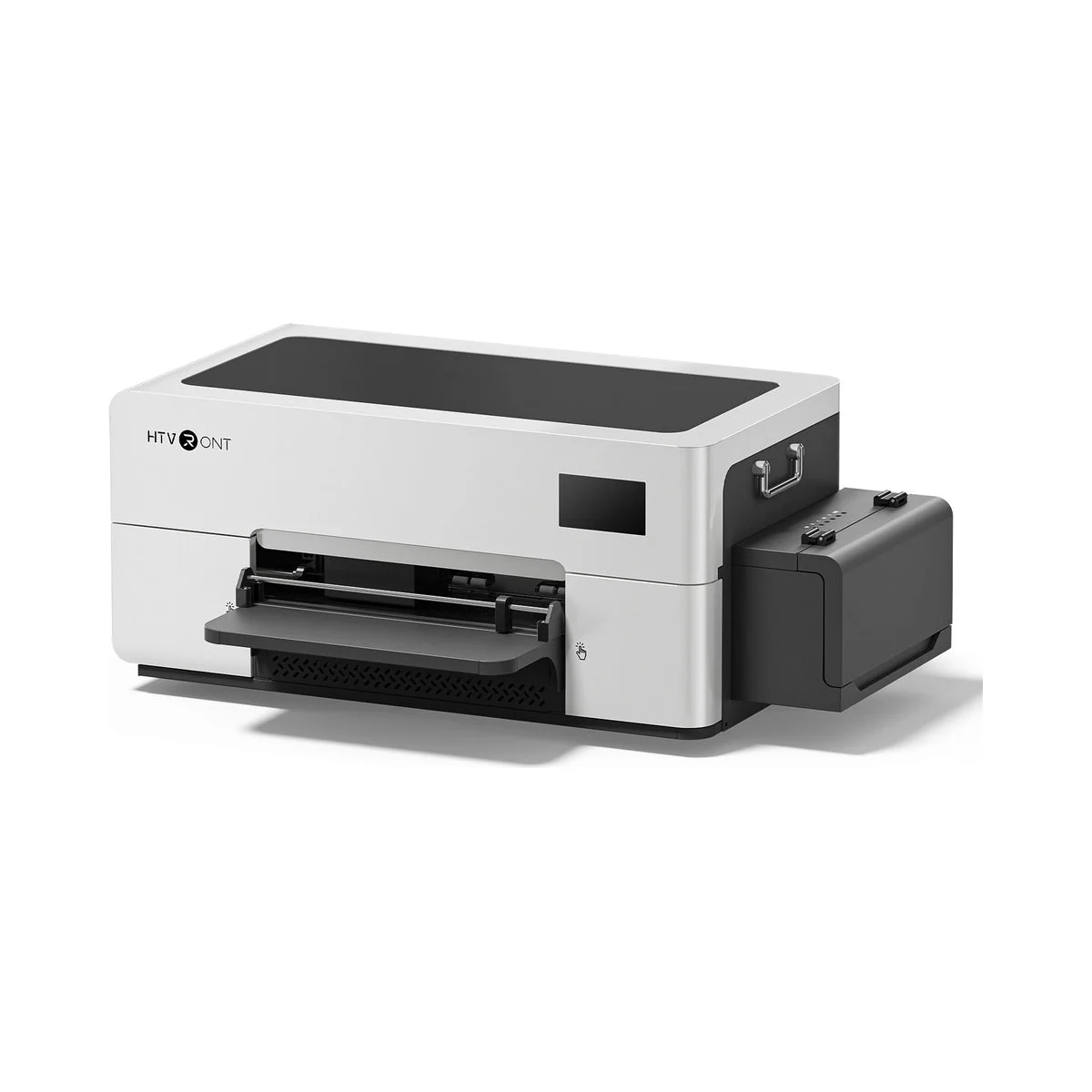
HTVRONT D2
Crafters moving up from a heat press who want a kit that arrives complete.
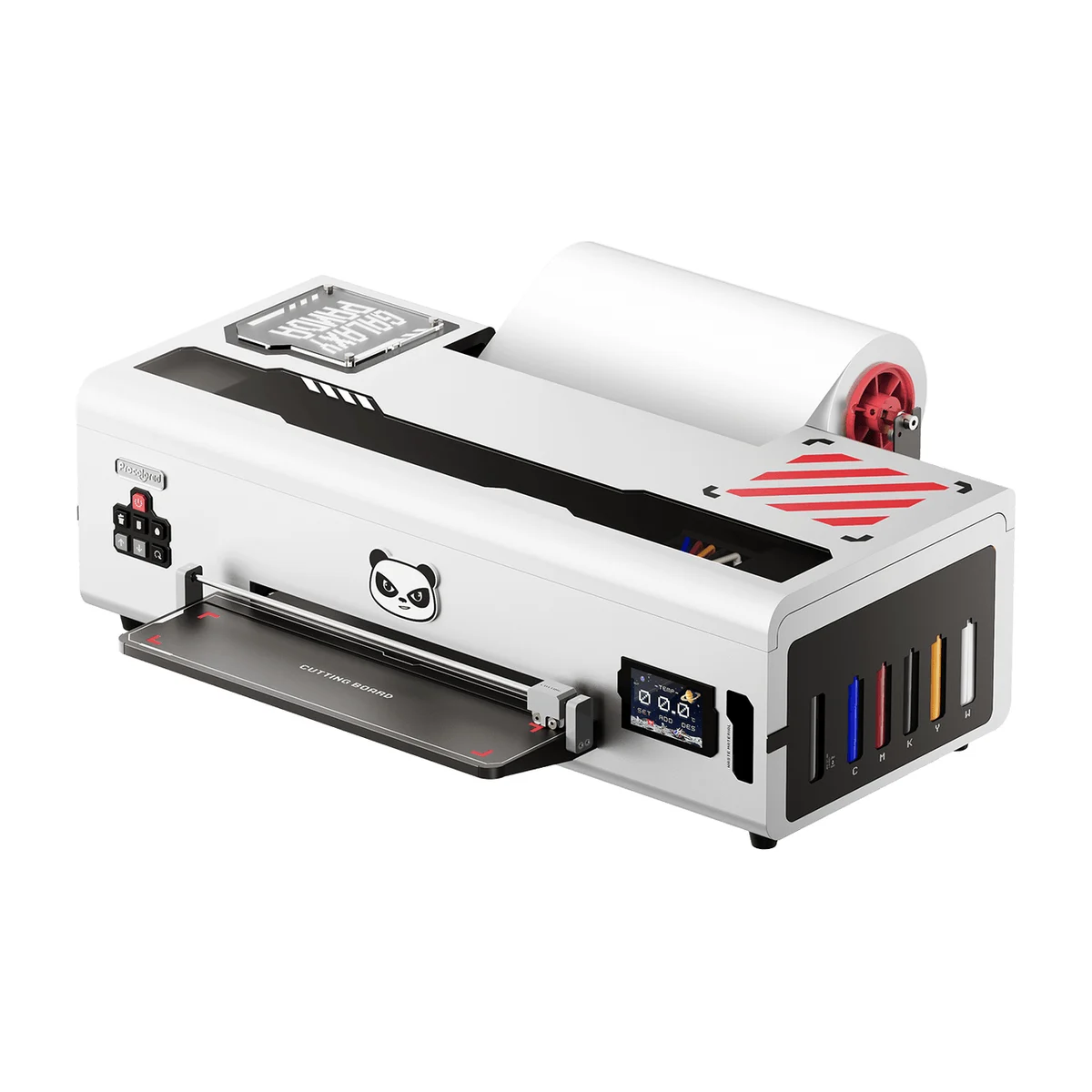
Procolored K13 Lite
A first DTF printer for a home shop printing up to a few dozen shirts a week.
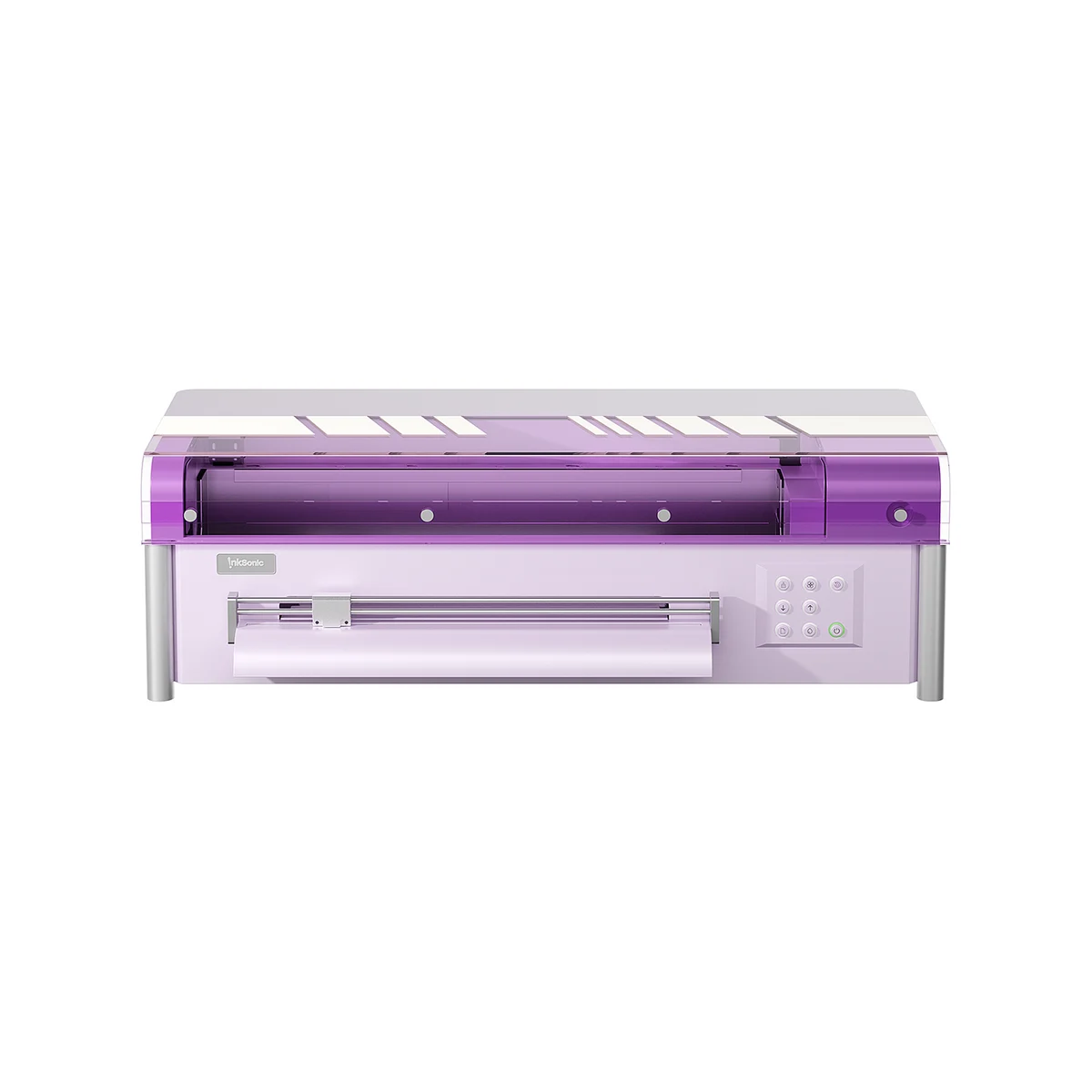
InkSonic Spark F13
The cheapest way to get an oven: printer plus oven for $2,199.